FedEx stock is plunging sharply after the company slashed profit targets and announced broad cost-cutting measures. The share price is down almost 41% from its all-time high of $273.66 reached in January, when everything looked so rosy. What happened?
Many experts would argue that the market finally realized that FedEx is not what it once was. The company’s fundamentals have been deteriorating in recent years, debt has been piling on and free cash flow has turned negative.
It is not a secret that market prices can move in the opposite direction of the fundamentals for a considerable amounts of time. FedEx is the latest example. However, knowing this did not help investors prepare for the imminent bearish reversal in the stock. The Elliott Wave Principle did, as proven by the chart below, published in mid-2017.

While FedEx stock was trading above $215 a share in June 2017, its weekly chart revealed a troubling picture. The uptrend from the 2009 bottom had taken the shape of a five-wave impulse, whose wave (5) was approaching to its end.
The Wave theory states that a three-wave correction follows every impulse, so it made sense to expect a major decline as soon as wave (5) ends. In addition, the company’s performance has been worsening, so caution was advised not only from the technical, but from the fundamental point of view, as well. The two methods of analysis do not always reach the same conclusion, but when they do, it is worth paying attention.
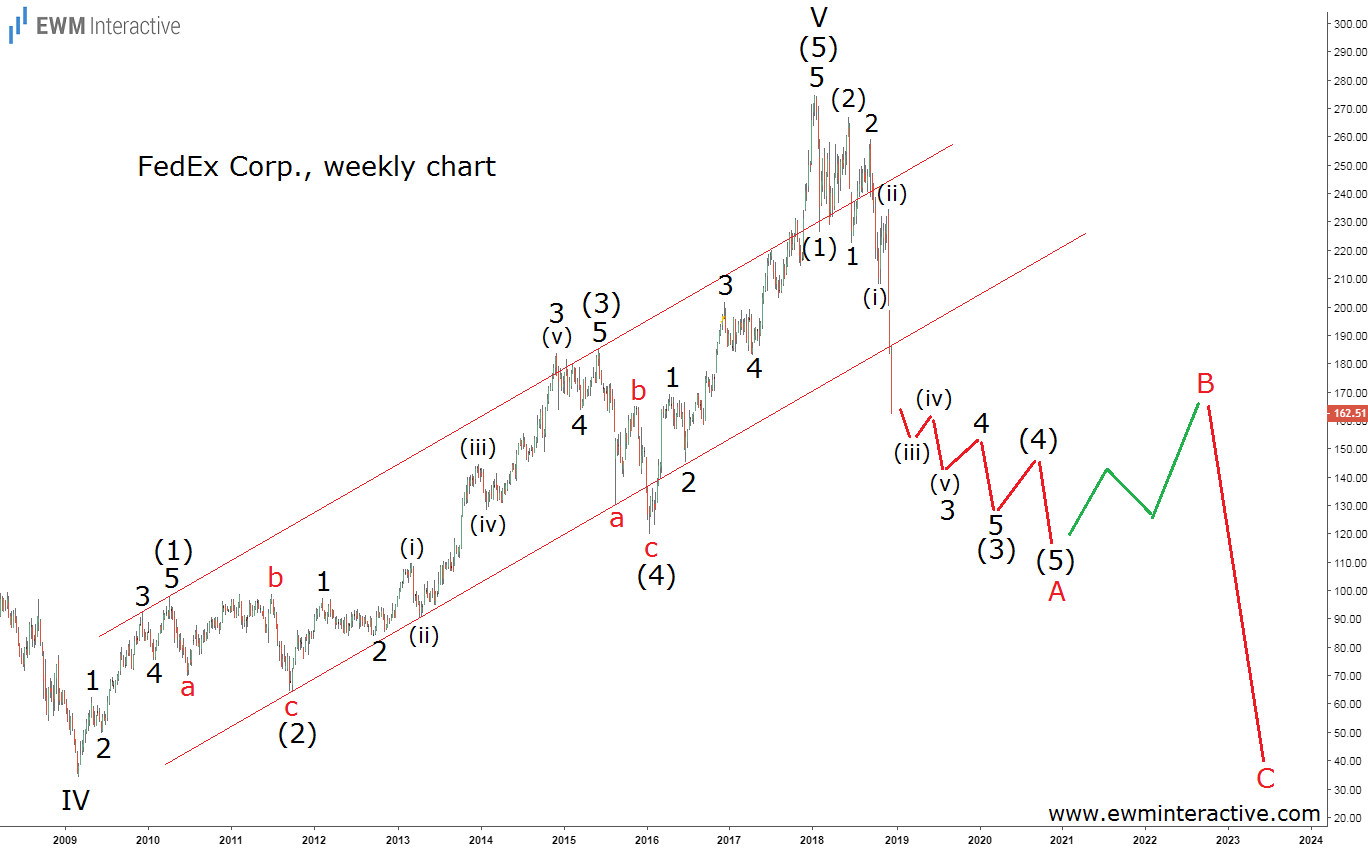
Picking tops is never worth the risk and FedEx is just another example of that fact. The bulls managed to keep the uptrend alive for another $60 per share until they reached the vicinity of $275 in January, 2018. However, they could not defy gravity forever and eventually made way for the bears, who cut the stock price almost in half in less than 12 months. In the end, investors who ignored the Elliott Wave warnings and kept buying only increased their losses.
The bad news is FDX’s woes are unlikely to go away any time soon. The support of wave (4) near $120 a share looks like a reasonable target for wave A of the larger A-B-C zigzag correction we believe is now in progress. Given the bad shape of the company and the bigger picture Elliott Wave outlook, we would not be surprised if this bear market erases all of the post-2009 gains.
In conclusion, it looks like there is still no bottom in sight for FedEx stock. Long-term bearish targets near $40 a share are plausible, which means the company can lose another 75% of its market cap from current levels. FDX may be down by 40% already, but it remains a very dangerous possession…
Did you like this analysis? Our Elliott Wave Video Course can teach you how to uncover similar dangers (and opportunities) yourself!